

By Marc Silver | Philly’s Top Real Estate Agent
Walkability and public transit access can support home values in Philadelphia, but there is no universal premium that applies to every property near a station. Buyers tend to pay for a useful daily routine: a manageable walk to groceries, coffee, parks, restaurants, and reliable SEPTA service. The value of that convenience depends on the particular block, housing type, station entrance, noise level, and quality of the walk itself.
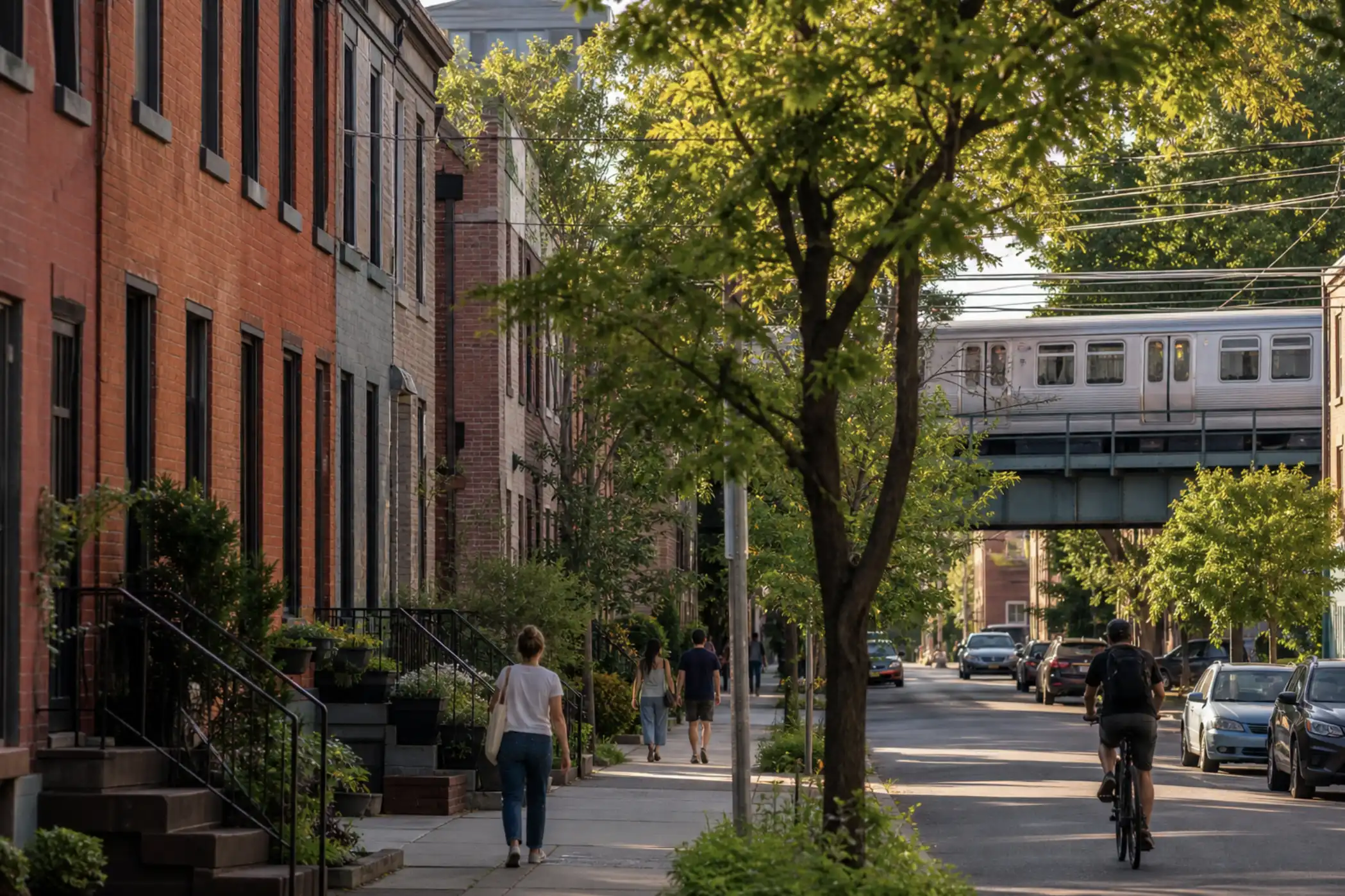
That last point is especially important in Philadelphia. Two houses may be the same distance from the Market-Frankford Line, yet one route involves active storefronts and comfortable sidewalks while the other crosses a wide arterial or passes beneath an elevated structure. After living in Philadelphia for more than 29 years, I have learned that buyers rarely experience those two walks as equivalent—even if a real estate portal does.
How walkability influences Philadelphia home values
Walkability has value because it can reduce the time and effort required to handle ordinary errands. A buyer who can reach a grocery store, neighborhood park, pharmacy, café, and transit stop without moving a car may see that convenience as part of the home itself. In compact neighborhoods such as Fishtown, Northern Liberties, and Society Hill, the surrounding blocks effectively become an extension of the property.
Online walkability ratings can help with an initial comparison, but they require context. The published Walk Score methodology considers proximity to amenities as well as pedestrian-related factors such as block length and intersection density. It cannot fully capture whether a route feels pleasant after dark, whether a steep front stoop is difficult with a stroller, or whether delivery traffic regularly blocks a corner.
Walkability also affects different buyers in different ways. A household commuting to Center City without a car may prioritize rapid transit, while someone working from home might care more about parks, cafés, and everyday services. An older buyer may place extra weight on sidewalk condition and easy building access. The strongest value signal is therefore not a score alone, but how well the location fits the routines of likely buyers.
Why SEPTA access can create a premium—and sometimes a tradeoff
People often use “metro access” as shorthand for proximity to Philadelphia’s subway and elevated rail network. In practical terms, buyers may also consider trolley, bus, and Regional Rail connections, depending on where they work and how often they travel. SEPTA’s official system map shows how these services connect, but a map does not tell the whole story of the trip from a particular front door.
A useful transit location combines several factors: walking time to the station, service frequency, transfers, station accessibility, and the comfort of the route. A home near the Market-Frankford Line can be particularly appealing to someone commuting between Fishtown, Old City, Center City, and University City because the line provides a direct east-west connection. Access to the Broad Street Line may matter more to a buyer whose routine centers on North Broad Street, Center City, South Philadelphia, or stadium-area destinations.
Being closest to the tracks is not always the same as having the most desirable position. Along portions of Front Street and Kensington Avenue, the elevated Market-Frankford Line can bring train noise, shadows, and activity around station areas. Some buyers gladly accept those conditions for a shorter commute, while others prefer to live several blocks away and walk a little farther. In appraisal and resale terms, both transit convenience and immediate site conditions need to be reflected in the comparable properties selected.
How transit and walkability differ across key Philadelphia neighborhoods
The following comparison is not a ranking. It shows why buyers should examine the type of access each neighborhood offers rather than treating “walkable” or “near SEPTA” as a single category.
Walkability and Transit Access in Four Philadelphia Neighborhoods
| Neighborhood | Key rail access | Typical housing context | What buyers should examine |
| Fishtown | Market-Frankford Line at Girard and Berks | Rowhomes, conversions, condos, and newer construction | Elevated-train noise, nightlife, and distance from Frankford Avenue |
| Northern Liberties | Market-Frankford Line at Spring Garden; Girard from northern sections | Historic rowhomes, infill homes, lofts, and condos | How quickly station access changes toward the west and north |
| Fairmount/Art Museum | Broad Street Line from the eastern side; bus connections elsewhere | Rowhomes, condos, and converted buildings | Longer rapid-transit walks closer to the museum and Parkway |
| Society Hill | Market-Frankford Line at 2nd Street and 5th Street/Independence Hall | Historic rowhouses and condominium buildings | Tourism, parking constraints, and distance from the northern stations |
Fishtown’s strongest transit-oriented locations are generally near the Girard and Berks stations on the Market-Frankford Line. Around Frankford Avenue and Girard Avenue, residents can combine train access with restaurants, music venues, shops, and daily services. The tradeoff is that nightlife, commercial deliveries, and the elevated tracks can change the sound and traffic pattern from one block to the next. A classic rowhouse on a quieter side street may therefore appeal to a different buyer than a newer condominium close to the busiest intersection.
Northern Liberties offers a similar lesson. The Spring Garden station provides Market-Frankford Line access near the neighborhood’s eastern side, while the Girard station can be practical from northern sections. The walk changes as you move toward 2nd Street, 4th Street, or the western edge of the neighborhood, so buyers should test the actual route rather than relying only on a radius drawn around a station.
Fairmount and the Art Museum area feel highly walkable in many respects, especially for access to neighborhood businesses, cultural institutions, and the Benjamin Franklin Parkway. Rapid-transit access is less uniform, however. The Fairmount station on the Broad Street Line is useful from the neighborhood’s eastern side, but homes closer to the Philadelphia Museum of Art can require a longer walk, a bus connection, or another mode. Buyers who love the Parkway and river trails may consider that a reasonable exchange; a daily subway commuter may calculate it differently.
Society Hill offers compact blocks, historic streets, and convenient access to Old City and Center City destinations. Market-Frankford Line stations at 2nd Street and 5th Street/Independence Hall sit near the neighborhood’s northern side rather than in its residential core. That separation can be attractive because it preserves quieter interior blocks, although weekend visitors, tourist activity, and limited parking remain important considerations near major historic attractions.
Why the individual block matters more than a neighborhood label
Philadelphia neighborhood names cover more variation than most listing descriptions acknowledge. In Fishtown, a property near Frankford Avenue may provide a very different daily experience from one closer to the river or several blocks farther north. In Fairmount, moving only a few blocks east or west can change the nearest transit option, the walk to the Parkway, and the amount of activity immediately outside the front door.
The city’s rowhouse pattern makes these block-by-block differences especially noticeable. A narrow side street may feel calm even when it is close to a busy commercial corridor, while a house directly on an arterial may offer convenient transit access but experience more buses, deliveries, headlights, and late-night activity. Buyers should also notice one-way traffic, loading zones, bike infrastructure, vacant lots, active construction, and the condition of the surrounding sidewalks.
Commercial trash collection is another detail that is easy to overlook during a daytime showing. Living near restaurants and businesses can be convenient, but it may also mean hearing dumpsters and trash trucks at three or four in the morning. I recommend asking nearby residents about collection schedules and returning to the block early in the morning if overnight noise is an important concern.
Proximity to a major nightlife thoroughfare also deserves attention. In concentrated entertainment areas, including parts of South Street, loud cars and amplified music can become especially noticeable when traffic slows or vehicles sit in place for several minutes. A property does not need to be directly beside a club or bar to experience that activity; sound often carries onto nearby residential blocks.
This is why I recommend visiting a potential home at more than one time of day. A weekday morning reveals commuting patterns, deliveries, commercial trash collection, and school traffic. An evening visit shows restaurant activity, parking demand, lighting, train noise, and nightlife. A weekend visit reveals whether the sidewalks function primarily as neighborhood gathering spaces or as routes to entertainment destinations.
Convenience matters, but so do peace, quiet, and the ability to feel comfortable in your own home. The right balance is personal, and two buyers may react very differently to the same active block. Spending time there beyond the scheduled showing is often the best way to understand whether that particular location fits your daily life.
A practical walkability and transit audit for buyers
Before assigning extra value to a walkable location, take the trip you would actually make. If the listing says a station is nearby, walk from the front door to the correct entrance rather than stopping at the edge of the station property. Check SEPTA’s current trip-planning information for the service you expect to use, because travel time can depend on transfers and time of day.
During the visit, pay attention to a short list of practical details:
- Walk to the nearest station, grocery option, park, and commercial corridor.
- Note major crossings, sidewalk conditions, lighting, and curb cuts along each route.
- Stand inside the property while a train or bus passes, particularly in front bedrooms and upper floors.
- Check whether restaurant seating, deliveries, entertainment venues, or school dismissal affect the block.
- Consider how the trip would feel in rain, summer heat, or while carrying groceries.
- Compare the property with recent sales offering genuinely similar transit access and street conditions.
For condominiums and converted buildings, the audit should include the building itself. An elevator, secure bicycle storage, package area, and easy street access can make a car-light lifestyle more practical. Conversely, several flights of stairs or awkward bicycle storage may offset some of the convenience suggested by the location.
How sellers can communicate a walkable location effectively
Sellers should describe how the location works rather than simply calling it “walkable.” A useful listing explanation might identify the nearest Market-Frankford Line station, the commercial corridor residents use for everyday errands, and the park or public space that shapes the block’s routine. Those details give buyers a more credible picture than a generic claim about being close to everything.
Accuracy matters. Walking times should reflect the correct station entrance and a realistic route, not a straight-line measurement. Sellers should also avoid promising a commute time that may change with service conditions. It is better to present verifiable access and let buyers evaluate it according to their own schedules.
Preparation inside the home can reinforce the location without overselling it. Good windows, functional heating and cooling, organized entry storage, and space for bicycles or strollers may matter more in an active urban setting. If the property is near nightlife or elevated rail, buyers will notice how well the interior manages sound, so that issue should be evaluated before listing rather than left to chance during showings.
Does every buyer pay more for walkability?
No. Some buyers prioritize a garage, larger interior space, a quiet residential setting, or easy highway access over being close to rail and commercial activity. Others are willing to accept less square footage because they expect to use neighborhood businesses, parks, and transit as part of daily life. That variation is why a fixed dollar amount per Walk Score point or per block from a SEPTA station is not a dependable way to price an individual Philadelphia home.
The relevant question is whether a property’s location creates useful access without imposing tradeoffs that its likely buyers will reject. In Philadelphia, the answer can change over just a few blocks. Careful pricing requires recent comparable sales, an understanding of the immediate street, and an honest assessment of how people will use the neighborhood.
If you are comparing homes near SEPTA, weighing walkability in Fishtown or Northern Liberties, or deciding how to market a well-located Philadelphia property, connect with Marc Silver at Silvertone Homes. I can help you evaluate the actual blocks, transit routes, housing types, and daily routines that listing photos and online scores cannot fully explain.
Sources and Further Reading
- SEPTA Maps — Philadelphia transit connections and the locations of Market-Frankford Line and Broad Street Line stations discussed in the article.
- Walk Score Methodology — The explanation that Walk Score considers proximity to amenities and pedestrian-related measures such as intersection density and block length.